
Paris, 26 November 2025 – Following the conclusion of its Materials Science Symposium in Paris, Ecocem, Europe’s leading provider of low-carbon cement technologies, today announces the establishment of its Materials Science Advisory Council to support the development and adoption of low-carbon cement solutions globally.
Comprising eleven of the world’s foremost materials scientists, drawn from leading global institutions, the Council will build on Ecocem’s longstanding collaboration with the scientists whose research has already contributed to Ecocem’s groundbreaking ACT technology which reduces CO2 emissions by 70% compared with traditional cement.
Cement accounts for 8% of global CO2 emissions and the Council’s mandate is to:
The creation of the Council follows the conclusion of Ecocem’s Science Symposium in Paris in November, where leading academics and industry stakeholders shared insights and updates on next generation low-carbon cement technologies and heard from construction industry partners on the large-scale deployment of low-carbon cement and concrete on live sites. Discussions on the industrialisation of low-carbon cement technologies identified the urgent need for more meaningful collaboration between science, policy, industry, and investors to close the gap between technical feasibility and market adoption.
 Commenting on the announcement, Donal O’Riain, Founder and Managing Director of Ecocem, said: “If we take the right action now, the cement industry can decarbonise globally by 2040 – ten years ahead of schedule, without excessive cost, and without carbon capture. We can already deliver a 70% reduction in CO2 without additional cost. What the industry needs is urgent alignment between research, regulation, policy, and practice, to move from demonstration to full-scale, global adoption.
Policy ambition drives progress and focusses resources and funding. Current policy supports only Carbon Capture, a single, expensive solution, rather than enabling a range of solutions which together can accelerate CO2 reduction. The Materials Science Advisory Council will work to build awareness and provide the independent scientific insight needed to maximise the industry’s potential to achieve decarbonisation of the sector ten years ahead of schedule.”
 Roberta Alfani, Director of Research & Innovation at Ecocem, added “Materials science has advanced to a point where the global decarbonisation of cement using alternative materials, and without major process investments is not just possible, it is a reality. But we need firm action today, and the purpose of the Materials Science Advisory Council is to provide science-based evidence and support continuous dialogue between leading academics, policy makers, industry partners, and funders.”
The establishment of the Materials Science Advisory Council marks the next step in Ecocem’s long-term commitment to innovation, scientific partnerships and delivering globally scalable solutions for cement decarbonisation. Over the past decade, Ecocem has invested more than €70 million in research and development, including its newly opened state of the art Research and Innovation Centre in France.
Other recent milestones include a new €50m ACT production plant in Dunkirk, a further €170 million investment to construct four new ACT production lines in France by 2030, and partnerships with leading construction firms such as Sisk, Cemex France, Bouygues Construction, Vinci Construction, CB Green, and the Titan Group.
The Advisory Council members include:
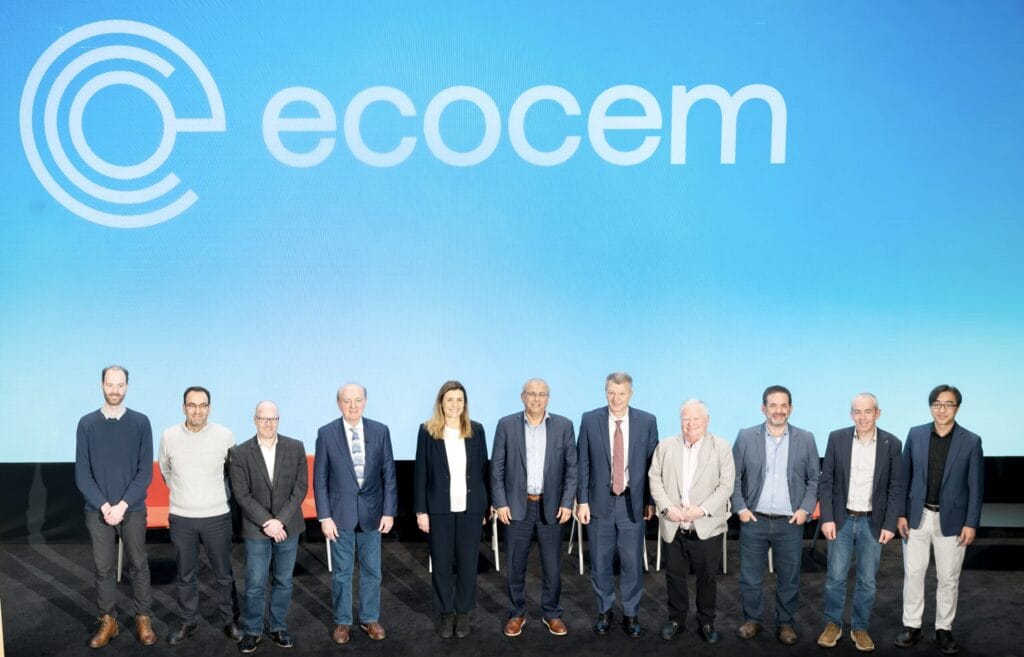
From left: Prof. Ruben Snellings – KU Leuven, Belgium. Dr. Mohend Chaouche – Université Paris-Saclay, France. Prof. Martin Cyr – Université de Toulouse, France. Donal O’Riain, Founder and Managing Director of Ecocem.Roberta Alfani, Research and Innovation Director, Ecocem.Prof. Arezki Tagnit Hamou – Université de Sherbrooke, Canada. Prof. Kamal Khayat – Missouri University of Science and Technology, USA. Prof. R. Douglas Hooton – University of Toronto, Canada. Prof. Rafael G. Pileggi – University of São Paulo, Brazil. Prof. Ciaran McNally – University College Dublin, Ireland. Dr. Hongyan Ma – Missouri University of Science and Technology, USA.
Ecocem is a pioneer of high-performance technology that cuts CO₂ emissions in the cement and construction industries. Its low-carbon cement technology, ACT, can reduce the global carbon footprint of traditional cement production by more than half.
For 25 years, Ecocem has developed and supplied low-carbon cement solutions across Europe. It operates from two plants in France, as well as sites in the Netherlands and Ireland, producing over two million tonnes of low-carbon cement each year.
Ecocem’s technology has supported major infrastructure projects including Le Grand Paris Express, Dublin’s Aviva Stadium, the Paris 2024 Athletes’ Village, and the UK’s HS2. To date, it has helped avoid 18 million tonnes of CO₂ emissions, equivalent to the annual absorption of over 800 million trees.
Investors include Saint-Gobain Group, Breakthrough Energy Ventures, and ArcelorMittal. In 2025, Ecocem announced more than €220 million of investment in new production capacity and R&I facilities to accelerate the commercialisation of ACT and support its Beyond Clinker strategy.
This includes €50 million for its first production facility at Dunkirk, increasing ACT capacity to over 1 million tonnes per year by 2026, and €170 million to build four new production lines in France.
An independent company with a world-class innovation centre, Ecocem technology and services can help the cement sector cut emissions by 50% by 2030 and build a more sustainable future.

At BATIMAT 2026, Chryso and Ecocem are unveiling a new solution resulting from their complementary expertise: Ecocem ACT low-carbon cement technology combined with EnviroMix® 3150 ACT, a new EnviroMix® admixture solution that was co-developed by Chryso and Ecocem.

World-first project validates more than a decade of research and demonstrates the scalability of breakthrough low-carbon cement technology
