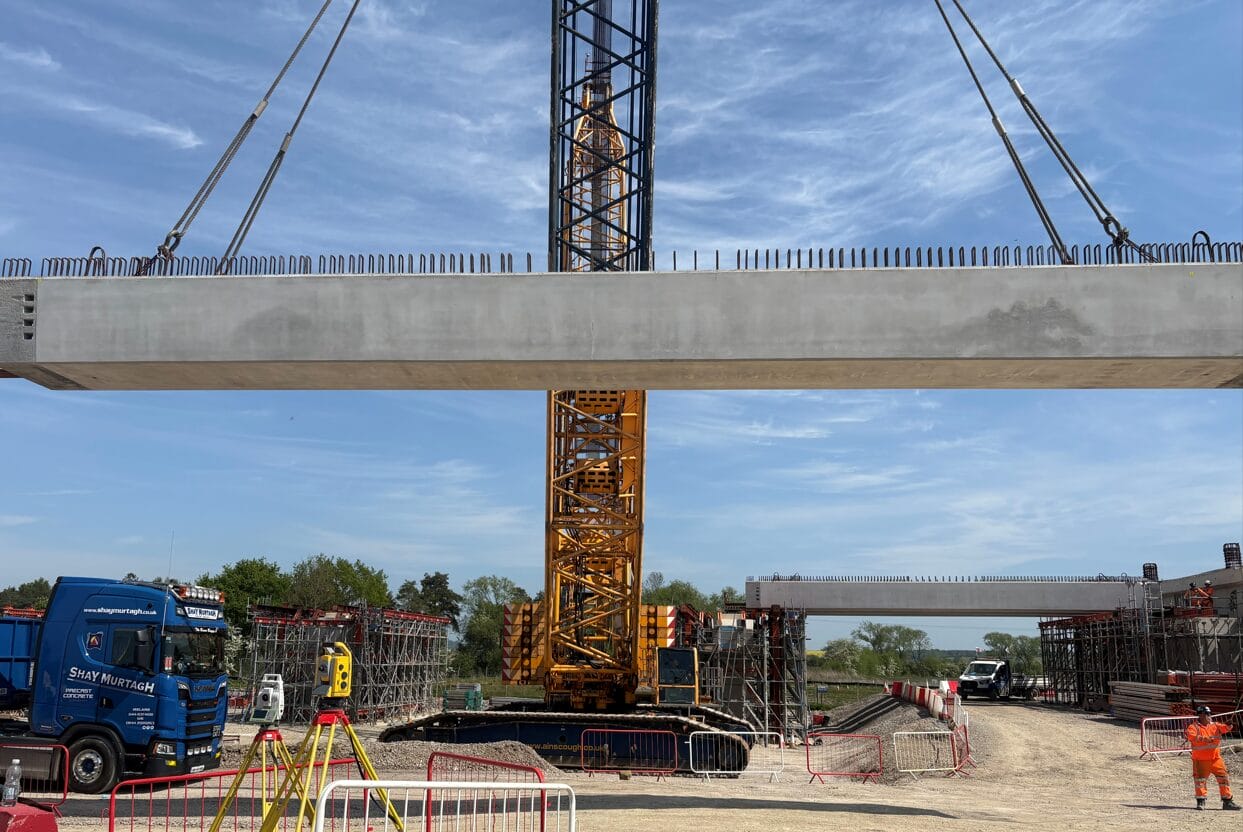
Over the last four decades, Shay Murtagh has become one of the leading precast concrete product manufacturers in Ireland and the UK. They now use 40% GGBS in all applications.
Over more than two decades, Shay Murtagh director Gillian Murtagh has been at the coalface of the Mullingar manufacturer’s efforts to reduce the impact of their activities on the environment. Onsite solar panels and wind turbines are set to take care of most of the company’s power needs by the end of this year.
Their Raharney base includes sixty acres of forest, which is managed within a comprehensive biodiversity plan. However, there was never any “We always knew however that until we addressed cement, we were at nothing.”
That’s why the company is now using recycled steel exclusively and is exploring the use of new SCMs to further reduce the high carbon content of their products.
“Concrete is a sustainable product, if it’s used properly,” says Gillian Murtagh. “GGBS has become a pillar of what we’re doing.”

Steve Lowe, a senior design engineer with the company, says the excellence required by a manufacturer like Shay Murtagh are evidence of GGBS’s potential. “If you can use it for what we’re doing, you can use it for anything,” he says.
Now Shay Murtagh has developed its own preferred blend of low-carbon cement that uses at least 36% GGBS (CEM III/A).
Initially, the business was drawn to using GGBS because it offers so much in terms of durability, design life and resistance to sulphates and chloride. Once the superior carbon profile was added in, the company became increasingly determined to maximise its use.
Shay Murtagh embarked on an intensive testing programme, and working with partners in the admixture industry, they were able to deliver GGBS concrete with the necessary early stage strength.
“In order to remain competitive and meet our customers’ programming requirements,’ says Steve, ‘we achieve that within three days.”
They use a number of methods to test and measure strength — including temperature match curing.
“It’s been an intensive process of laboratory testing to confirm that we’re achieving those concrete grades, and we also do substantial testing for workability requirements.”
Steve explained the sort of resistance from customers and contractors that their work set out to overcome: “There is an early strength gain delay in concrete that uses a higher percentage of GGBS. That’s why it’s often claimed it’s not realistic or viable for use with structurally intensive concrete — particularly for pre-stressed bridge beams and
other precast highway structure components.”
The time spent on research and testing means that all of the technical challenges that they were able to imagine at the start of their journey have now been overcome.

Now that finding the right mix is a settled science embodied carbon means that design optimisation plays a bigger role.
The technical team at Shay Murtagh collaborates with its customers and partners to analyse every design rigorously and, through the collective experience, is able to recommend ways that can reduce the volume of steel or concrete involved in delivering on engineering goals.
The happy byproduct of optimising designs like this is a reduce project cost because of the reduced material cost.
This is value engineering in the true sense of the word — delivering higher quality structures at lower cost and with lower embodied carbon.
Shay Murtagh has used CEM III/A in a wide range of high profile projects in Ireland and the UK. Notably this include’s the UK’s new high speed railway — HS2. At the project’s Solihull interchange station, the company manufactured and delivered 15 colossal pre-cast concrete bridge beams. Each one is 46 metres long and weighs up to 565 tonnes. All were made on CEM III/A.
Until recently most of this business was being done in the UK but a combination of factors means mean that demand is set to rise rapidly at home — with embodied carbon calculation and reduction demanded by new public procurement rules, corporate sustainability pressures.
As a consequence, solutions developed and tested by a pioneering Irish concrete product manufacturer for the UK market can be brought to bear at home, offering the Irish construction industry tried-and-tested low carbon concrete solutions as the market shifts decisively towards decarbonisation.

At BATIMAT 2026, Chryso and Ecocem are unveiling a new solution resulting from their complementary expertise: Ecocem ACT low-carbon cement technology combined with EnviroMix® 3150 ACT, a new EnviroMix® admixture solution that was co-developed by Chryso and Ecocem.

Dating back to 1843, the Dún Laoghaire Baths is an award-winning redevelopment that has put long-term thinking at the heart of a public project.
